
By Solana Kline, [lifelong animal adoption advocate and honorary four-legger]
It was a steady stream of human hikers until finally, after two days, I see a four-legger bounding up the trail: pack on his back, hot and happy face, quick to lay in the shade and drink some water at the Surveys for Snacks station.
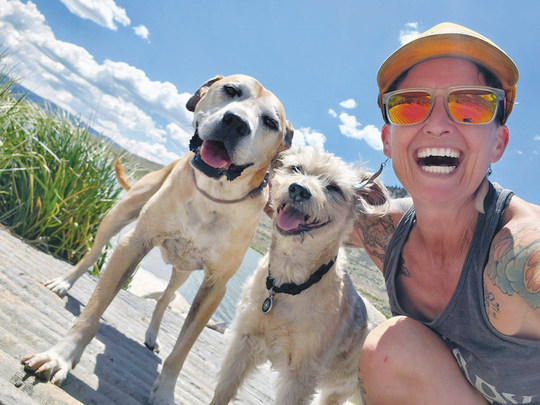
Jake’s grin was delightful, bright white K9’s and summer tongue lolling out to cartoonish lengths. His human, Aster, meandered up soon after. They’ve been on the trail for two months now—Continental Divide adventurers midway on their 3,100 mile journey from Mexico to Canada, tracing the ridges and peaks that decide which ocean a single drop of rain will ultimately travel to.
Me and the pack are up in the Colorado high country doing field research on the non-monetary value of our U.S. public lands and trails, (aka: how us folks on the ground really value these spaces and activities). As usually happens, I fall into conversation with the trail-goers. I am, of course, all eyes on Jake, making sure he has his fill of snacks and laps and shade and ear scratches.
“He’s usually pretty avoidant of people.” Aster says.
“They always know the dog-people who have the best snackies,” I say with a smile and a wink to Jake. “How is your journey going?”
Aster tells me he is an army veteran, and he adopted Jake when he got home from service and was struggling to re-integrate.
“This is the only place I feel sane, where I can be myself and be with Jake, where I can heal, where we can be wild and free, where we can be a pack, where I don’t feel the PTS. I tell you one thing, the U.S. government would be paying a hell of a lot more in psychological treatments if we didn’t have adopted pups and U.S. public lands for our veterans. I’d never do it without Jake. We need it. Out here, we are exactly where and who we are supposed to be, and I don’t feel like there is something wrong with me.”
They stayed for awhile and chatted. I packed them down with treats and they headed back on trail, walking off into the sunset together like the magical duo they are.
These two made an impression on me, hitting two of my core heart causes: rescue pets and veterans. Our U.S. culture doesn’t do a great job of recognizing the rights, realities, and lives of the four-leggers or our U.S. veterans. And, to make things worse, unless they have served, a large swathe of Americans just aren’t accustomed to thinking about the daily realities of veterans, in particular combat veterans.
My dad was a green beret before his career as a smokejumper across the West. But I didn’t grow up with him, or any other servicemembers. It wasn’t until I was in my early thirties that I met the human love of my life, Jimmy, an Iraq combat vet. Soon after, I met one of my dearest friends, Greg, retired career Air Force commanding officer.
I’ve had the immense honor to meet veterans of all walks of life and all variations of experiences while in service. I’m grateful for their service, for the stories they share, grateful they survived. Of the veterans I now call family, nearly all of them have adopted dogs, fostered a pack of their own, have forged life and healing with their pups.
The emotional, mental, and physical benefits of adopting dogs for veterans and their pups are vast. As a pack, veterans and their dogs sleep better, foster relationships and community, encourage exercise and outdoor nature time, lower stress, provide sense of purpose, create home together, and help calm PTS symptoms.
These relationships have proved so impactful that, in 2022, President Biden signed the Puppies Assisting Wounded Servicemembers for Veterans Therapy Act (PAWS), that requires the VA to run pilot and long-term programs connecting veterans with service dogs. National recognition of these benefits is important for establishing a baseline of practice that can encourage dog adoption as a recommendation of care to save our veterans and our shelter pups out there.
This is essential considering that every day in the US, roughly 18 veterans commit suicide (VA.gov). And, every day in the US, approximately 880 dogs are euthanized (ASPCA.org, Bestfriends.org). These stats have declined slightly over the past decade but still sit at staggeringly high numbers. (Sources: tinyurl.com/jwyczrdm; tinyurl.com/48mpsmxm)
In response to both of these systemic issues, many organizations have sprouted up to help both veterans and four-leggers. Arizona currently has 483,619 veterans, and the estimate for adoptable dogs in Arizona is anywhere from 2,000 to 4,000. These are great odds for co-placement with the right training and programming in place.
Organizations bringing these vets and pets together are filling a few different niches. They offer varied services like training rescue dogs and placing them with veterans, leading trail adventures for veterans and their adopted pups, providing free adoptions for veterans, providing free veterinary and food care for pets of vets, and more.

Soldier’s Best Friend in Peoria (soldiersbestfriend.org) brings together rescue dogs with veterans living with Traumatic Brain Injury (TBI) and/or Post Traumatic Stress (PTS). Their goal is to help veterans and homeless pets by training the veterans and the dogs to, “build a trusting relationship that touches two lives at once.”
How does the process work? Veterans first apply to their training program, are accepted, and are paired with a pup who has been adopted from the local shelters by Soldier’s Best Friend. Once paired, the veteran and pup get to live and train together, attending two training sessions per week for six to nine months. Training moves far beyond basic obedience—although it includes this as well; rescue pups in this training become fully qualified Service or Therapeutic Companion Dogs. Soldiers Best Friend offers trainings across Arizona: Phoenix, Tucson, Prescott, Sierra Vista, Flagstaff, Yuma, and Kingman.
Local animal shelters also offer veteran specific programs. For example, Pinal County Animal Control and Care runs their Pets for Vets program where vets can adopt pets over a year old for free (pinal.gov/455/Adoption). Valley Dogs (valleydogs.org)—which is a no-kill animal rescue—offers a Vets & Their Pets program that provides free food, veterinary care, and temporary housing for pets of vets when veterans need to access medical care or are experiencing transitions in housing.
Underdog Rescue partners with Pets for Patriots (more info at tinyurl.com/3ahea5fu), providing reduced adoption fees for veterans. Pets for Patriots (petsforpatriots.org/veterans/) is a national organization that offers membership for veterans and connects them with local rescues for free or low-cost adoptions. They also have organized local networks of discounted food, veterinary partners, discounted pet insurance and veterinary telehealth care.
These organizations and programs make a world of difference for our veterans and our shelter pups. Here’s sending out a hearty wag and arf to all our local human and pet heroes.
Until next time, happy tails and happy trails.
Author’s Note: I am looking to interview our local vets and their pets and the local organizations that make those connections possible. If you are a local veteran living with an adopted pet and would like to share your pack’s story, I would love to speak with you and feature you in an arfticle, send me an email: solana@klineconsulting.org or call 970-422-2042.
