
By Heidi Dahms Foster
On September 11, 2001, terrorists hijacked four commercial aircraft, crashing two into the World Trade Center towers and causing their collapse, one into the Pentagon, and a fourth in Pennsylvania after passengers and crew resisted.
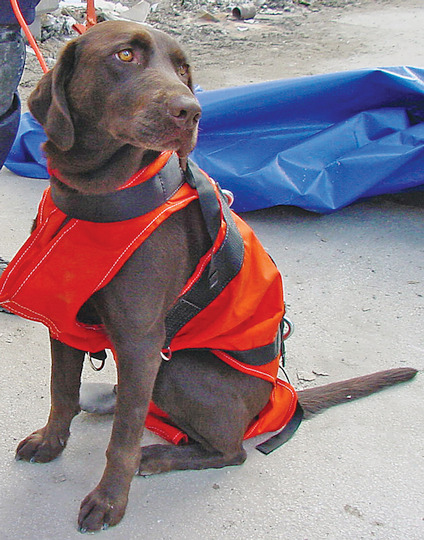
In the aftermath, first responders and volunteers played a huge role in bringing closure to the families and friends of the 2,977 people who died in the attacks. Among these were 300 canine heroes, highly trained search and rescue and therapy dogs that, with their handlers, brought hope and comfort to families of those who died and to the first responders working the disaster. The legacy of those four-footed heroes lives on 25 years later.
Then Central Yavapai Fire District Battalion Chief Pruett Small—a Prescott Valley resident at the time—was a supervisor on the Southwest Area Type 1 Incident Management Team, currently part of 17 such teams nationwide that specialize in planning, mapping, supply orders and coordination, rescue and safety.
The devastation at Ground Zero was overwhelming, and during an interview in early October 2001, Small mentioned the impact of the dogs on emergency personnel. “Everyone has pets at home,” Small said at the time. “It’s a reminder of normal life. Seeing the wag of a dog’s tail reminds you, ‘Hey, there’s still some good things out there.’”
More than 300 search and rescue, recovery, and therapy dogs were deployed to Ground Zero, the Pentagon, and the Flight 93 crash site in Shanksville, Pennsylvania following the September 11 attacks. These dogs worked in hazardous, unstable wreckage to find survivors and recover remains.
Dogs and their handlers navigated dangerous wreckage to locate remains, bringing closure to families whose loved ones died in the attacks. The 9/11 Memorial & Museum article, Four Legged 9/11 Heroes, stated that as time passed, rescue and recovery workers realized the chance of finding survivors was slim. As rescue operations changed to a recovery mission, cadaver dogs—trained to find human remains—were brought onto the scene.
Working alongside their handlers, the four-legged heroes worked tirelessly climbing huge piles of debris while fires still smoldered. The search for signs of life or human remains was mentally and physically taxing on the dogs. The dogs began to get discouraged and lose their search drive.
Aware of the importance of morale in these dogs and to keep their motivation high, their handlers would stage a “mock find” so the dogs could feel successful. Veterinarians were stationed at the site to help care for the dogs, which worked twelve-hour shifts and more on the pile.
In an interview with the American Kennel Club, Dr. Cynthia M. Otto, a veterinarian who worked at Ground Zero and the founder of the Penn Vet Working Dog Center, said the work of the dogs during 9/11 is what made her facility possible, and changed forever the perception of search dogs and their value. Search dogs had been around for decades, but the public had little understanding of what they could do.
“There was some sense that they might be able to find a lost Boy Scout in the woods, but nothing of the scope and impact of a national disaster (even though they had a critical role in the Oklahoma City bombing and several natural disasters),” said Dr. Otto. She said media coverage of 9/11 focused on the dogs as the one “ray of sunshine” in a bleak landscape, as Pruett Small found as a first responder.
Another organization that played a big part in the operations at Ground Zero, according to the AKC, was the nonprofit National Disaster Search Dog Foundation (NSDF), founded in 1995 by retired teacher Wilma Melville. The Oklahoma City bombing in 1995 was her first deployment, and she recognized a need for more dogs specifically trained for this kind of work. Shortly after, she founded the NSDF.
“Most people in this country had never heard of disaster search dogs [before 9/11],” said NSDF Executive Director Debra Tosch. When the news media started focusing on the dogs at Ground Zero, she said, “public knowledge really exploded.”
Tosch, and her NSDF-trained black Labrador Retriever, Abby, were among the Federal Emergency Management Agency (FEMA)-certified canine search specialists—part of California Task Force 1—at the World Trade Center.
Tosch estimated that of the 300 search teams that responded to 9/11 disaster locations, only about 100 were prepared for a disaster of such proportions in a major city. Many were wilderness search and rescue dogs, experts at finding people missing in the woods. They could not cope with the enormous mounds of twisted metal and glass, the smoldering rubble, and the urban noises.
But Tosch said television coverage of the search dogs caused awareness and funding that helped to make the National Training Center, a twenty-year dream of Tosch’s, a reality. “It’s designed to give canine candidates the opportunity to practice on a variety of simulated disaster sites,” she said.
Along with the search dogs, therapy dogs also played a crucial role post 9/11. Ursula Kempe co-founded Therapy Dogs International, in the mid-1970s. TDI sent 100 teams to New York, where they worked at the Family Assistance Center on Pier 94 and Pier 50 at the Pentagon. They spent about four weeks there.
As time passed after 9/11, the stories of these courageous and invaluable dogs continued to emerge, one by one.
The only working dog that lost its life directly in 9/11 was Sirius, a yellow Labrador retriever and explosives detection dog for the Port Authority of New York and New Jersey Police Department.
Sirius died in his kennel in the basement level of the South Tower (2 World Trade Center) when the building collapsed on September 11, 2001. His remains were recovered on January 21, 2002, with a Police Honor Guard present. His collar, badge and training leash are displayed in the National September 11 Memorial & Museum exhibition dedicated to 9/11 working dogs.
Trakr, a German Shepherd dog, was responsible for finding the last of only 20 survivors, Genelle Guzman-McMillan, beneath the rubble 27 hours after the collapse of the World Trade Centers. Trakr searched for two days on the pile, finally collapsing from smoke inhalation, exhaustion, and painful burns. After he was treated for his injuries, he returned home to fully retire as a police dog.
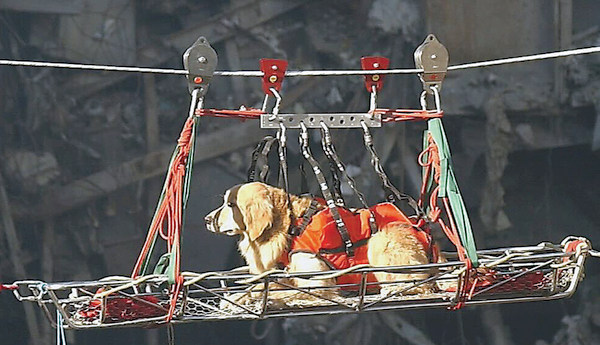
Riley, a four-year-old golden retriever, is featured in one of the most famous photos from 9/11 as he was transported above debris at the World Trade Center. Riley was not trained to be a cadaver dog, and after finding only lifeless bodies, he became depressed. He was reassigned as a comfort dog, helping relieve stress from firefighters and police working through the rubble. Riley passed away in 2010 at 13 due to cancer believed to have been caused by his 9/11 rescue missions.
Apollo, a German Shepherd, was the first canine responder at the 9/11 scene, arriving at the South Tower just 15 minutes after its collapse. Only two years old, this German Shepherd graduated from the New York Police Department’s Special Operations Division and became one of the city’s top dogs in the 1990s, working with the first K-9 Urban Search and Rescue team. Apollo searched for survivors for 18 hours a day for weeks before he had to be forced to stop from exhaustion.
Bretagne, a Golden Retriever believed to be the last surviving 9/11 Ground Zero search dog, died at age 16 in 2016. She was a member of the Federal Emergency Management Agency. She worked 12 hours a day for two weeks, uncovering numerous victims who had died. Sept. 11 “was her first mission, but she worked it like a pro,” said her handler Denise Corliss in an interview with Scripps News. “A lot of times, firefighters would come by and pet her, talk to her and tell her stories.”
Sage was a Border Collie who deployed to the Pentagon and successfully recovered the remains of the terrorist who piloted American Airlines Flight 77.
These are just a few of the memorable dogs of 9/11. Each of these 300 dogs is a story in itself.
In the AKC interview, Dr. Otto said that she believes the need for dogs trained for all kinds of serious work is going to increase even more in the future. More money, facilities, and people willing to become handlers are desperately needed. “There is a shortage of dogs and funds to support them,” she says, “as well as the research to keep them healthy and performing optimally.”
“People are realizing all of the different ways we can use these K-9s,” Tosch added. “We’re only limited by our imagination.”
