Story and photos by Cheryl Hartz
It isn’t the tallest or even the widest, but for sheer volume, the General Sherman Tree in California’s Sequoia National Forest contains more wood it its trunk than any other tree in the world – 52,508 cubic feet, to be exact. In total biomass, also measuring branches, roots and foliage, it’s still Number One. It’s also one of the oldest, at an estimated 2,200 years.
If you require an urban reference to imagine the scope of these giants, Sequoia trees can grow as tall as a 26-story building with bases as wide as a city street. Naturalist John Muir coined the name, Giant Forest, after his visit in 1875.
But Sequoia was not established as a national park until 1890. Buffalo soldiers kept it safe in 1903 and their commander, Charles Young, was the first African-American superintendent of any national park.
Volcanic and glacial landforms in the Sierra Nevada mountain range, also called the High Sierras, are what make conducive conditions allowing sequoias to grow to such massive proportions.
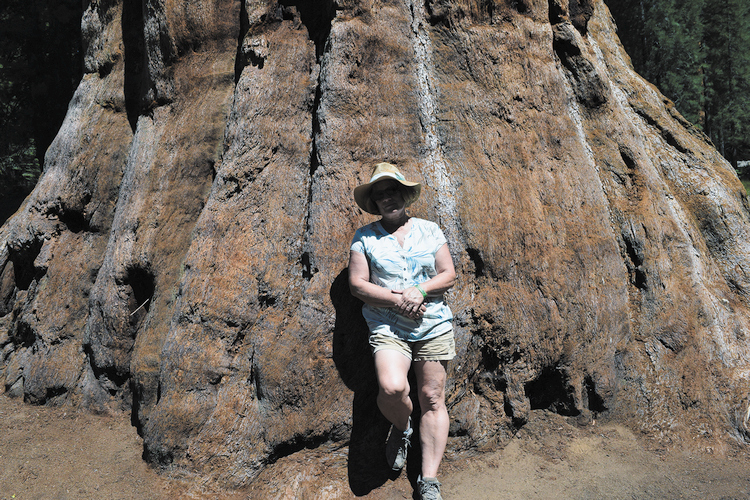
To stand beneath the General Sherman Tree and many more spectacular trees in the Giant Forest, including the President Tree, the Chief Sequoyah Tree and the McKinley Tree, you’ll hit the Congress Trail, a paved 3-mile loop.
Keep an eye out for Douglas squirrels. When pine cones fall near you with regularity, a squirrel is cutting them to gather up for lunch.
The seeds the squirrel misses are ready to sprout if provided with a sunny, clear bed of ashes. This is where forest fire, so devastating in the West, can be beneficial. The U.S. Forest Service states that: “Most fires in a sequoia forest burn low to the ground. They are relatively cool, as fires go.” So those fires don’t normally kill mature sequoias, but can reduce the number of thinner-barked trees, leaving more open space for sequoia seeds to become saplings.
“Of all the paths you take in life, make sure a few of them are dirt.”
– John Muir
To experience a dirt path in the park, the one-mile loop of the Big Trees Trail is ideal. Interpretive exhibits about the natural history of sequoias skirt a meadow profuse with a wide variety of plants.
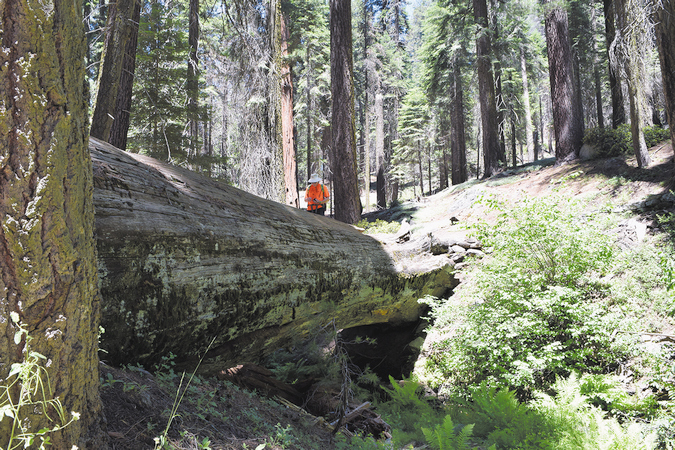
Plenty of trails abound in Sequoia National Park, but they don’t allow dogs. Our two napped briefly in the topper-covered bed of our pick-up, parked in the deep shade, as we explored the Big Trees Trail a bit, getting a chance to traverse an immense log serving as a bridge across a shallow wash.
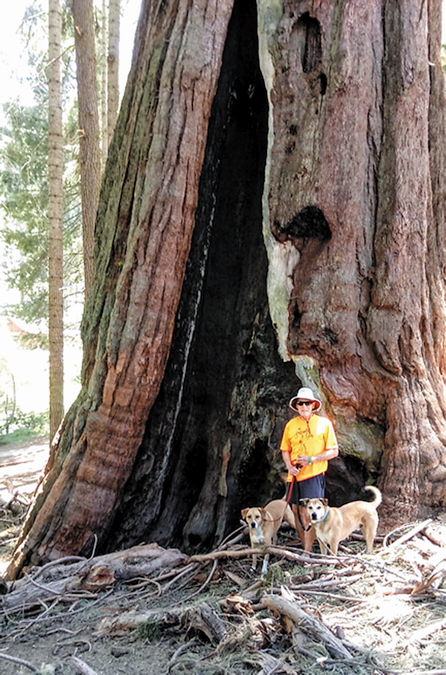
The pups got their chance to get up close and personal (i.e. lift their legs) next to some of the giant trees off-trail next to the parking lot.
I hope you also get a chance to visit the Giant Forest, if for no other reason than to feel very young in the scheme of things.
Happy youthful hiking!
like any other tree