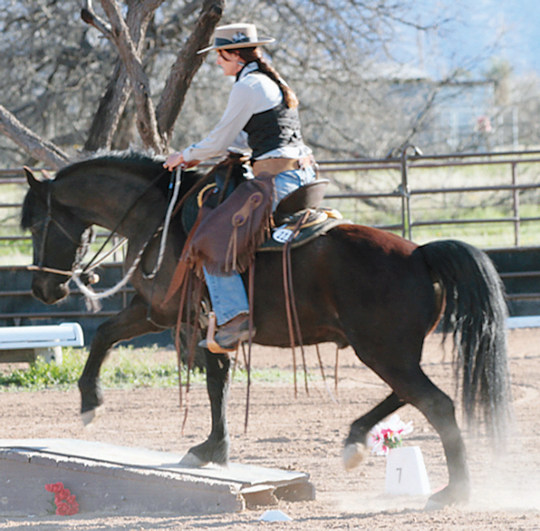
By Rita Thompson Tinsley
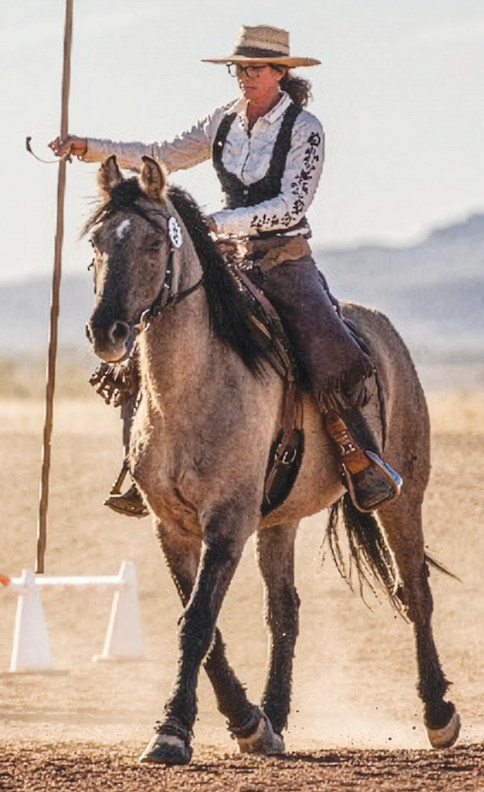
Let’s face it. Every horse needs a job. They know it. We recognize it. This might just be the most fun, dynamic, and adventurous collaboration where you and your horse can apply.
Meet Swiss-born Tessa Nicolet, founder of Cohesive Horsemanship. She began her journey with horses very young in life. Tessa, as early as 11 years old, was putting first rides on many a young horse that she was working with in her family’s New Mexico business. She spent countless hours with these horses face to face, on the ground, before ever sitting in the saddle. It was important to build a foundation of trust with them to ensure safety for both her and the horse.
Today, that foundation has helped Tessa’s focus on building a genuine partnership between humans and their horses based on mutual trust, confidence, and respect. Her program is amazingly designed to teach both rider and ride to become integral partners accomplishing specific goals which translate remarkably to Working Equitation.
Modern day Working Equitation is a sport borrowed from the old world, rich in history, reflecting riding traditions originating from Spain, Portugal, France, and Italy. Each country has contributed their influence, such as the skills of the traditional vaqueros, referred to as Spanish cowboys. Working Equitation tests the partnership skills of both horse and rider in four categories: dressage, ease of handling (manageability), speed trial, and cattle-work trials. (Go to usawe.org for specifics.)
USA Working Equitation is a fairly new sport which is growing in leaps and gallops. Why is it becoming so popular? According to Amy Star, a WE Masters Level rider serving also as a US and Canadian judge for the events, “Because it’s fun and safe with a dressage foundation and (uniquely) a speed trial.”
She applauds Tessa Nicolet’s launching of Cohesive Horsemanship, stating “She helps people to progress and preserves the integrity of both rider and horse.” Amy is responsible for forming the Arizona Working Equitation Club, which you can find at azwec.com
Michele Sharp came from Endurance Riding with her Arabian horses. She was ready for a change and participated in one of Tessa’s workshops to learn more. She and horse Abel began at Level 2 but are going to be moving up to Level 4.
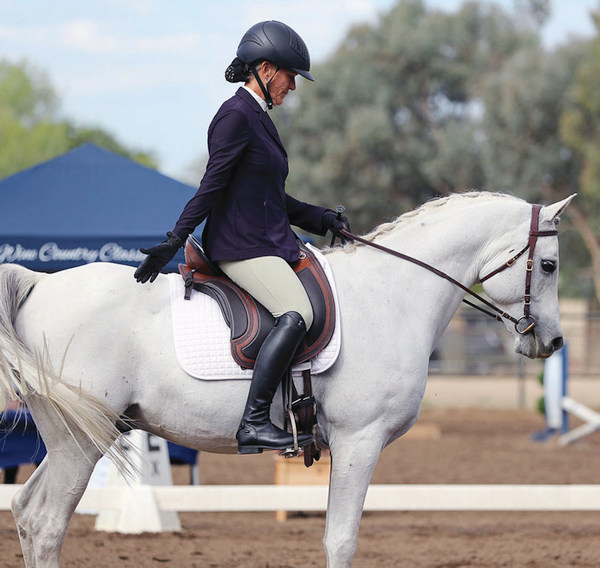
in California. Photo by Brooke Louise
Michele loves the French Classical Dressage training, where the horse is more symmetrical. She doesn’t do a warm-up practice on obstacles with Abel, claiming that “If you do the dressage work well, the obstacles will go well too.”
Besides competing with Abel, Michele has also entered WE events riding her buckskin Lusitano Pingamor. Michele and Abel recently traveled to California for the US Working Equitation Regional finals.
Melody Smith grew up on working ranches in Wickenburg, where she learned first survival riding, “cuz if you fall off, it’s a long walk home, and there weren’t cell phones!”
Later in life, when Melody’s 7-year-old daughter wanted to learn to ride English, they not only learned English riding together but spent the next nine years competing in Eventing (a rigorous sport that includes dressage and jumping).
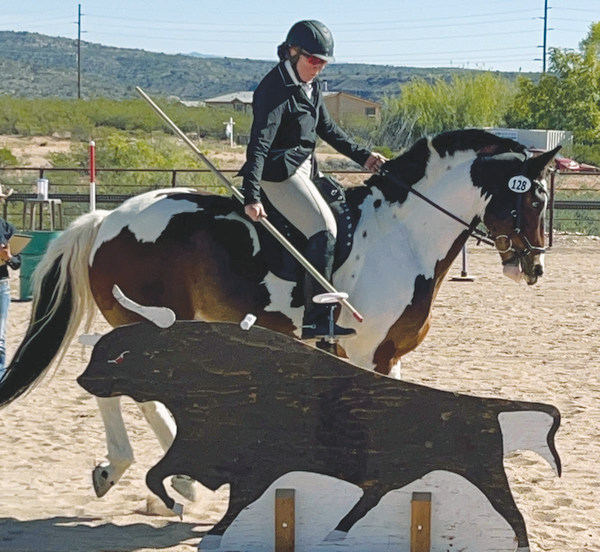
Spear a Ring. Photo by Richard Smith
After Melody’s daughter went off to college, Smith was left with two young Warmbloods that still needed to work, “yet hubby didn’t want me to continue Eventing,” she states. So, she tried Working Equitation with first Zorro and Cruz, and now also 5-year-old Warlander, Eldorado. Melody and her horses have done tremendously well, starting at Level 3, but now two horses are moving to Level 4.
Regarding the obstacle course, “The goal is to make your ride look effortless with a forward-balanced horse,” says Melody. She has won the Speed Round on Cruz at least five times, who despite being a huge Canadian Sport Horse, is extremely athletic.
The Working Equitation community cordially welcomes riders from all disciplines and horses of all breeds with unrivaled support and camaraderie. Quarter Horses are common as are mustangs, and many others.
In earlier times, Spain brought its Doma Vaquera tradition and the vaqueros working their Pure Spanish Horses. France’s Gardians were managing their Camarque horses. Italy had the Butteri expertly handling their Murgesen horses, while Portugal’s skilled riders sat their amazing Lusitanos, bred over centuries as war horses.
A sport that brings to life the old world’s magical mounts performing traditional farm and ranch work, could be you on your backyard beauty with endless effort and sensible schooling.